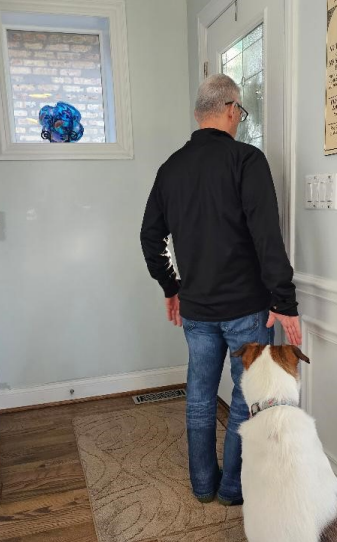
🐶 What Is “Splitting” in Dogs?
Splitting is a subtle but powerful calming signal first described by Norwegian trainer Turid Rugaas in her book Barking: The Sound of a Language. It’s a behavior dogs use to diffuse tension, prevent conflict, and reassure others.
For example, when two dogs appear on edge, a third might walk between them, turn sideways, or look away. This quiet movement acts as a natural signal that says, “Hey, let’s keep things calm.”
Dogs also “split” their humans—like stepping between you and another dog or person—when they sense tension or excitement. It’s not dominance; it’s communication.
Check out this great video showing a Boston Terrier splitting two other dogs. The split comes right at the end of the video.
💬 Why Humans Should Learn to Split
We can use splitting to communicate to our dogs that we’ve got the situation handled. It’s especially useful for dogs who are anxious or dogs that bark at:
-
The front door
-
Passersby out the window
-
People or dogs on walks
When you “split” your dog, you’re saying in their language:
“Hey, I’ve got this. No need to keep warning me with a warning bark.”
This simple acknowledgment relieves your dog’s anxiety and frustration and reduces barking because they feel heard.
🚪 How to Practice Splitting at the Door
It’s easiest to start at your front door—ideally with the door open and a closed storm door so your dog can see outside. Doors offer a narrow field of view that makes it easier for you to stay between your dog and whatever stimulus has them anxious.
Once your dog understands at the door, you can generalize the behavior to windows or fences, which usually cover a wider visual field and may be harder at first.
🧍 The Keys to Effective Splitting
The essence of splitting is calm, quiet body language. When you use it, remember:
-
No talking
-
No touching
-
No direct eye contact
Simply walk between your dog and the trigger. Pause. If you’re still in the early stages, you will need to physically get up and walk into your dog’s space to “split.”
Look in the direction of the trigger or stimulus for a few seconds, then turn away, say “Good boy”, and walk away, inviting them to follow you. (See [Follow Me training link])
Alternatively, you can walk past your dog, turn, and cue a hand target. (See [Hand Target link]).
With consistent practice, many dogs will eventually respond just to their name and a hand cue—no need to get up at all.
🚶 Using Splitting on Walks
Once your dog recognizes the cue, you can use splitting during walks whenever your dog becomes alert or anxious about someone approaching, a loud truck or another dog,
-
Place yourself between your dog and the source of your dog’s anxiety.
-
Simultaneously, create distance for your dog by arcing away from the object.
-
Remain calm. Fake it if you have to. A dog can notice a one-centimeter change in the width of your lips.
- Do not tighten up on the leash. This tells your dog, “You should be anxious.”
Do it right and you’re telling your dog, “Thanks for the warning. I’ve got the situation under control.”
🧠 Why Splitting Works
Splitting reduces frustration, uncertainty, and arousal. Your dog barks because they feel responsible for alerting you. Once they see you respond, their job is done.
By using splitting, you help your dog feel safe, understood, and heard—which builds trust and strengthens your bond.
💡 Final Thoughts
Splitting is one of the most underused communication tools in dog training. It’s quiet, intuitive, and deeply respectful of how dogs naturally navigate social tension.
Once you’ve practiced it at home and on walks, you may begin to notice your dog looking at you for direction instead of becoming anxious — not because you “trained” it, but because you finally spoke their language.
Here’s a document I created on Splitting that will give you a bit more detail, and here’s a link to Turid’s book, Barking: The Sound of a Language. It’s an excellent, very short read that will also educate you about the other 8 types of barks she has identified.
