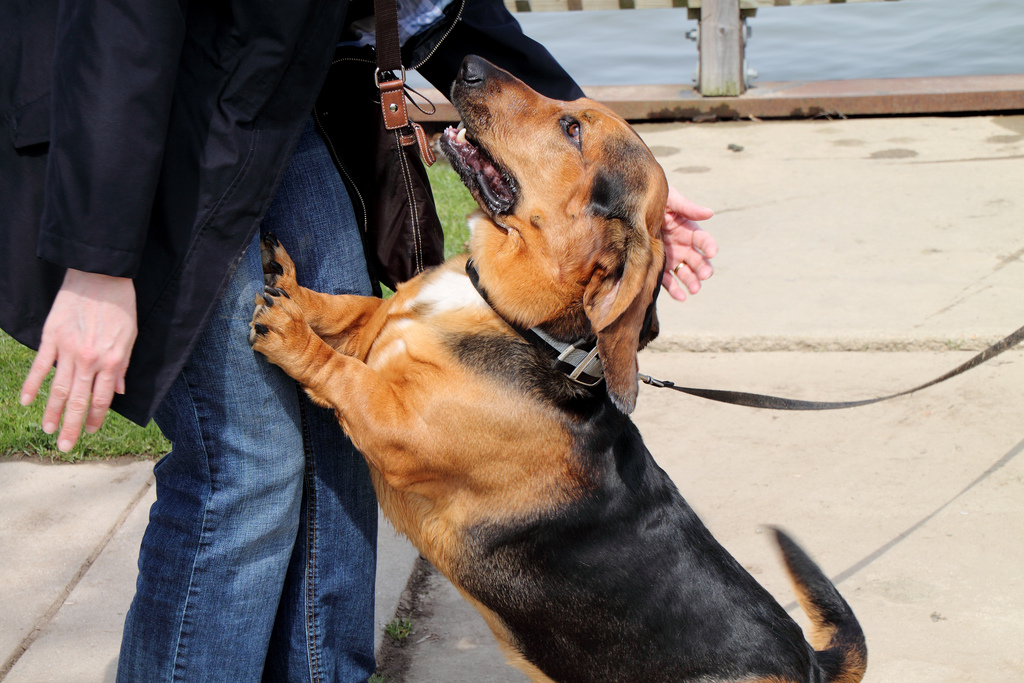
🐶 Why Dogs Jump
-
Dogs don’t jump to “dominate” or “disobey.” They jump because it works. From a puppy’s point of view, jumping has always gotten results in the form of eye contact, talking, touching, even pushing your dog off and saying no is attention and reinforces the behavior.
-
Attention is rewarding for your dog. So every time we say “no,” push them off, welcome their affection, or even look at them, we’re actually making the behavior we don’t want stronger!
-
It’s important to understand that jumping on you may not bother you and you may even like it, and that’s okay. However, your guests, children or people you meet on the street may not like it because they’re wearing nice clothes or they’re intimidated by dogs. Also, older people and children are scratched more easily because of their softer skin.
-
The solution is to teach your dog to jump on you when you ask (on cue). This turns it into a trained behavior rather than an impulsive one.
-
But first, you have to stop the uninvited jump.
🙈 The Power of Negative Punishment
In behavioral science, negative punishment means taking away something the dog wants in order to reduce a behavior. In this case, what your dog wants is you.
So instead of scolding, pushing, or saying “off,” the most effective thing you can do is:
-
Don’t speak.
-
Don’t look.
-
Don’t touch.
-
Instead, quickly turn away.
If you turn and bend down to your dog as soon as their paws are on the ground, you’ll help them learn “four paws on the floor makes attention happen. Jumping makes it go away.” Repeat this every time for faster results.
If you just want to manage the behavior (prevent it and stop it from becoming stronger) because it’s not a good time for you to have a learning moment, turn away and do not give them your attention while they are jumping.
🚪 When Turning Away Isn’t Enough
Some dogs are more persistent, and they’ll jump on your back, nip your pants, or bark for you to turn around. When that happens:
-
Calmly, but quickly and robotically (repeat with no emotion) walk away.
-
Step into another room.
-
Close the door for a 3 – 5 seconds.
-
Re-enter to give your dog another chance.
If they jump again, repeat. Your dog will quickly learn that the only way to make you stay (and get your attention) is by keeping all four paws on the floor.
Leave the room without returning to manage, but if you have time, and patience slowly open the door and attempt to enter. As soon as you see paws leaving the ground slowly start closing the door. This opening and closing of the door sends the same message as turning away and back: “four paws on the floor makes attention happen. Jumping makes it go away.” Repeat this every time for faster results.
👥 When Guests Come Over
When new people arrive, excitement peaks, and guests won’t have had the opportunity to practice, like you have, so it’s not fair to expect them to strictly follow your guidance. Instead, manage jumping behavior by using a leash and harness:
-
Clip the leash to your dog’s harness.
-
Stand on the leash so your dog has just enough slack to stand, but not jump.
-
Ask guests to ignore the dog until all four paws are on the floor.
Once calm behavior happens, that’s when attention can return.
💡 Stay Consistent
Consistency is everything. If jumping sometimes gets attention, (remember, even a look is attention) your dog will try even harder. You’ve just taught your dog persistence. But if every single time jumping makes attention disappear, and every single time calm behavior earns attention, your dog will learn fast!
Some dogs learn quickly, but it takes time for other. How long they’ve practiced this behavior is a big part of this but stick with it. It always works.
🐶⬆️ Teaching Your Dog to Jump on Cue
It’s perfectly fine to enjoy your dog jumping on you. Many people love that greeting. What’s important is teaching your dog when it’s okay and when it’s not. That way, your dog can still express affection without jumping on others uninvited.
To do this right, follow these steps:
-
Eliminate uninvited jumping first.
Before teaching your dog to jump on cue, they must understand that spontaneous or uninvited jumping never works. Only when you ask for it will it be rewarded. -
Wait until your dog is past puppyhood.
Around 1.5 years old is a good time to start, once joints are mature and balance is stable. Puppies shouldn’t be encouraged to jump because of their developing joints, and it encourages their impulsive nature. -
Introduce a clear cue.
Start by patting both palms on your chest while standing. If your dog doesn’t jump, that’s great, it just means your earlier training was effective. -
Make it easier if needed.
Try kneeling or sitting in a chair to lower your body height. Pat your chest again. If your dog still doesn’t jump, use a visible treat in your hand as a lure as you pat your chest. -
Fade the lure.
After just a few repetitions (4–5 is usually enough), practice without the treat in your hand. You want the chest pat itself to become the cue, not the sight of the food. -
Keep greetings structured.
Practice in short sessions and always end before your dog gets overly excited. Remember, this is an invited behavior, not a free-for-all. -
Need help refining it or changing it to a verbal cue?
Visit www.doglifepro.com for help fading the lure and shaping the cue into a clean, reliable behavior. Just a couple of chest pats. Here’s a link on how to develop a verbal cue.
🦴 Related Reading
-
Stop jumping, mouthing, nipping and demand barking document.
-
EasyWalk harness for introductions to guests.
